
Kazakhstan’s leading financial institution is combining advanced engineering, flexible coworking environments and thoughtful integration with the urban fabric.
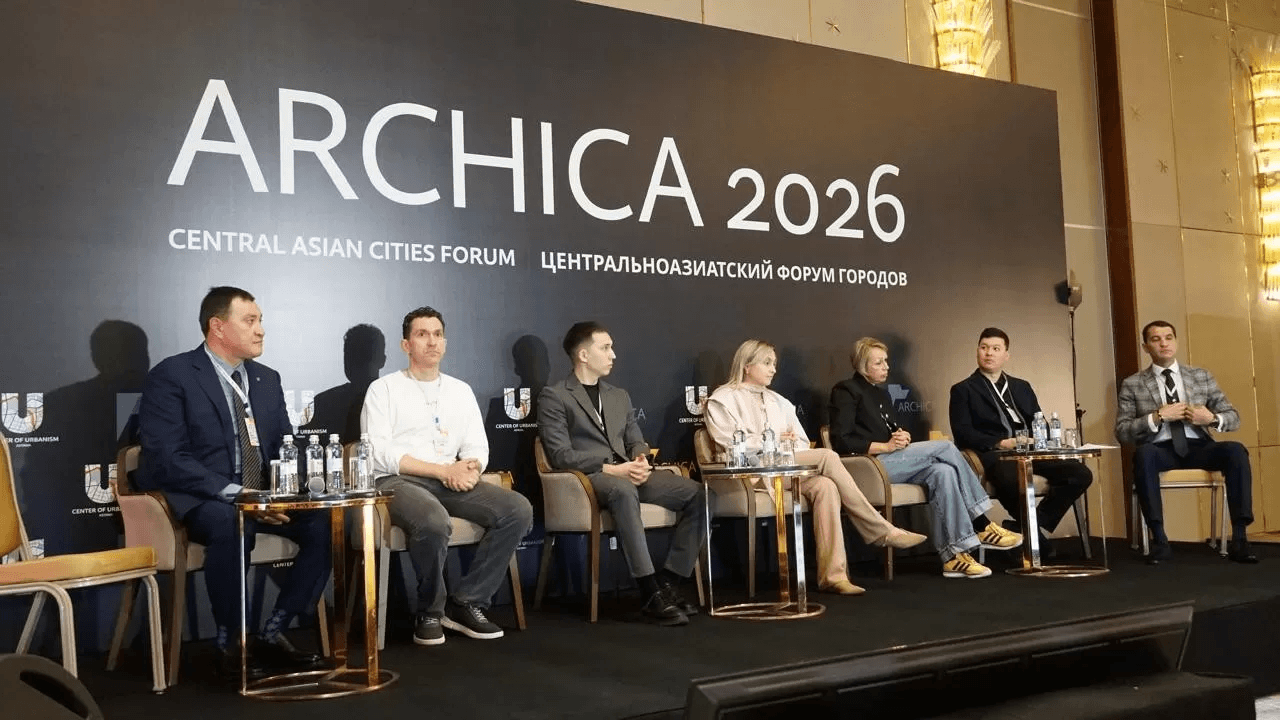
Photo: Nurlan Alzhabayev/ Tengrinews
The international architectural forum ARCHICA took place in Astana, bringing together leaders from the financial sector, internationally recognized experts, urbanists and developers. Discussions on the future of cities featured specialists from Zaha Hadid Architects, Foster + Partners, Chapman Taylor, Arup and MYAA, as well as the London based team at Barker Langham, known for developing cultural narratives and storytelling strategies for cities.
The forum focused on the transformation of workplace environments, the growing role of artificial intelligence in design, and the development of a distinctive architectural identity for cities across Central Asia.
One of the central themes was the evolution of commercial real estate and the concept of the office of the future. Yertai Salimov, Deputy Chairman of the Management Board of Halyk Bank, presented the bank’s strategic approach to designing and developing major real estate projects.

According to Salimov, creating contemporary architecture for a large-scale financial ecosystem is not simply about following trends. It requires a carefully considered balance between functionality for employees and long-term architectural value for the city. When developing new projects, Halyk Bank works with a planning horizon of 20 to 30 years, deliberately moving away from short-lived architectural fashions in favour of enduring solutions.
«We do not chase the architectural trends of the moment. We create fundamental, timeless architecture that integrates harmoniously into the urban landscape and has the potential to become a defining landmark of its region,» Yertai Salimov emphasized.
A clear example of this approach is Halyk Bank’s new complex in Astana. Rather than developing a conventional vertical office tower, the project adopts a horizontal configuration focused on flexibility and large open spaces. The building incorporates engineering solutions that are unprecedented within Kazakhstan’s banking sector. It's main atrium rises 12 metres without a single supporting column, using structural bridge systems that carry another five office floors above the space. Between the two buildings, at the level of the third to fifth floors, a 30-metre elevated bridge weighing approximately 500 tonnes creates another distinctive architectural feature. Inside, it accommodates a contemporary coworking environment designed for informal collaboration between employees.

The architectural language of the complex combines neoclassical references with contemporary technology. The facade is finished in natural limestone and complemented by large-scale glazing and high-quality aluminium elements. Flexible layouts and modular engineering systems allow office areas to be adapted to new operational requirements without major structural reconstruction.
Particular attention has also been given to the environmental quality of the workplace. An intelligent climate-control system can operate in multiple modes simultaneously. While spaces exposed to direct sunlight are being cooled, areas on the opposite side of the building can be gently heated, maintaining a consistent and comfortable internal climate.
The complex is also designed as an integral part of the city. The buildings have been positioned deeper within the site, creating space for a landscaped pedestrian area and public garden in front of the development. These areas are accessible not only to employees and clients, but to all city residents. Internal circulation has also been carefully organized, with separate flows for employees, customers and visitors.
The same principle of individuality is applied across Halyk Bank’s regional projects. The new Halyk Bank office in Atyrau has already become a recognizable visual landmark of Kazakhstan’s oil capital, while the Tenge Bank building in Tashkent combines contemporary architectural standards with elements inspired by local cultural and architectural traditions.
As Salimov explained, Halyk Bank’s projects in Astana, Atyrau and Tashkent are united by shared principles of reliability, openness and ergonomics. At the same time, each building responds individually to its local climate and cultural context — from Astana’s strong winds and Atyrau’s hot climate to Uzbekistan’s architectural traditions.
«Transport accessibility, infrastructure, public spaces and landscaping all determine how comfortably people can get to work and experience the city throughout the day. This is why dialogue between businesses, architects, developers and municipal authorities is especially important,» Salimov concluded.
The experience shared by business leaders at ARCHICA also highlighted a broader shift in contemporary architecture: buildings can no longer be considered in isolation from the urban environment around them.
According to Indira Makhmetova, Project Director of ARCHICA, one of the forum’s main objectives is to move beyond the traditional understanding of architecture as a collection of individual buildings or development projects.
«We are talking about the need to develop entire territories through cultural master planning and programming. This is a unique subject that has not previously been addressed at this level in Kazakhstan or Central Asia. We are discussing how people and cities experience their identity and how we can create environments that are comfortable for every resident,» Indira Makhmetova said.
A particular emphasis at ARCHICA was placed on developing long-term principles for urban development.
One of the key outcomes of the forum will be the signing of the Astana Manifesto, a document being developed jointly by international speakers, the Urban Center, AstanaGenPlan and the city’s Department of Culture.
Source: inbusiness.kz